
What Is Baguazhang?
Baguazhang, also written as Bagua Zhang or Pa Kua Chang, is a traditional Chinese internal martial art known for circle walking, spiraling body movement, smooth turning, and powerful palm techniques. The name is often translated as “Eight Trigram Palm.” It is one of the major internal martial arts of China, along with Taijiquan and Xingyiquan.
Many people first notice Baguazhang because it looks so different from other martial arts. Instead of moving only in straight lines, Baguazhang practitioners walk in circles, turn the body, change direction, and move with a coiling quality through the waist, spine, arms, and legs.
But Baguazhang is more than an unusual-looking martial art. It is a complete practice for developing balance, coordination, awareness, mobility, self-defense skill, and calm focus. It teaches the body how to stay rooted while moving and how to change direction without losing center.
At Dragon Phoenix in Asheville, NC, Baguazhang is taught as part of a traditional internal martial arts curriculum that also includes Taijiquan, Xingyiquan, Qigong, Kung Fu, and Shuai Jiao. Dragon Phoenix describes its school as Western North Carolina’s Tai Chi and Internal Kung Fu Center, offering classes for all ages and levels in a welcoming environment.
What Does Baguazhang Mean?
The word Baguazhang can be broken into two parts.
“Bagua” refers to the Eight Trigrams, which come from classical Chinese philosophy and the Yijing, or Book of Changes. “Zhang” means palm. So Baguazhang is commonly translated as “Eight Trigram Palm.”
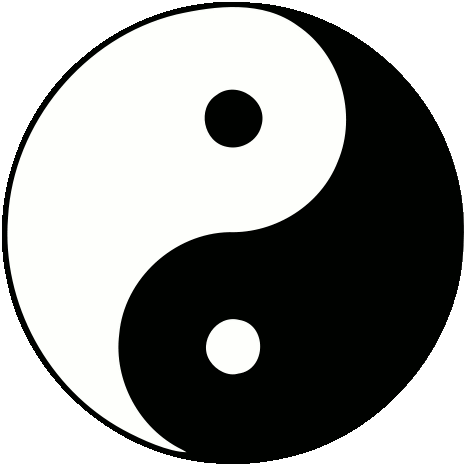
The idea of change is at the heart of the art. In Baguazhang, the student learns not to meet force with stiffness. Instead, the body turns, redirects, circles, enters from an angle, and finds a new path.
This is one of the deeper lessons of Bagua training. In life, we often get stuck because we only know how to push harder in one direction. Baguazhang teaches another way. It teaches us how to change while staying centered.
Why Is Baguazhang Called an Internal Martial Art?
Baguazhang is called an internal martial art because it emphasizes structure, alignment, breath, intention, relaxation, and whole-body connection. Power is not created by arm strength alone. It comes from the coordinated movement of the feet, legs, waist, spine, shoulders, arms, and palms.
This does not mean Baguazhang is weak or only for health. It is a martial art. But the strength is trained from the inside out.
A small turn of the waist can become a strike. A step can become an entry. A change of angle can become a defense. The whole body learns to move as one complete unit.
This type of training takes patience, but it builds something deep. Students learn how to move with less tension, more awareness, and greater confidence.
Circle Walking: The Foundation of Baguazhang
The most recognizable practice in Baguazhang is circle walking. Students walk around a circle while holding specific postures, changing palms, turning the body, and learning how to remain balanced while moving.
Circle walking may look simple, but it trains many things at once:
Balance
Leg strength
Coordination
Posture
Footwork
Breath awareness
Focus
Hip and waist mobility
Calmness under pressure
In today’s world, many people spend long hours sitting, driving, typing, and looking down at screens. Baguazhang asks the body to wake up again. The steady circular walking encourages the legs, spine, eyes, hands, and mind to work together.
Over time, students often feel more grounded, more mobile, and more connected to their bodies.
Is Baguazhang Good for Health?
Baguazhang is a martial art, but it can also be practiced in a way that supports health, balance, posture, coordination, and mindful movement.
There is less peer-reviewed research specifically on Baguazhang than there is on Tai Chi and Qigong. However, Baguazhang shares many qualities with these practices, including slow mindful movement, weight shifting, postural awareness, breath coordination, balance training, and relaxation.
A comprehensive review of Tai Chi and Qigong research found evidence of positive effects in areas such as balance, cardiopulmonary fitness, bone health, quality of life, and psychological well-being. Another review found strong evidence for Tai Chi in fall prevention, along with benefits for conditions such as osteoarthritis, Parkinson disease, and chronic obstructive pulmonary disease rehabilitation. A 2024 meta-analysis also found that Tai Chi exercise can improve balance performance in healthy older adults.
Baguazhang is not the same as Tai Chi, so we should not pretend the research is identical. But the research does support the value of mindful internal movement practices that train balance, coordination, relaxation, and whole-body awareness.
For many students, Baguazhang offers a practice that is both physically engaging and mentally calming.
What Is Baguazhang Used For?
Baguazhang can be practiced for several reasons. Some students are interested in traditional Chinese martial arts. Some want better balance, posture, and coordination. Some are looking for self-defense training. Others want a mindful movement practice that feels deeper than ordinary exercise.
Baguazhang training may include:
Circle walking
Standing postures
Palm changes
Forms
Footwork
Striking
Throws
Joint control
Partner drills
Self-defense applications
Qigong and internal body mechanics
The martial side of Baguazhang teaches a student to move around force instead of crashing into it. Rather than standing directly in front of pressure, the practitioner learns to angle, turn, redirect, enter, and control.
This is why Baguazhang is often described as an art of change. It teaches the body and mind how to adapt.
Is Baguazhang Good for Self-Defense?
Baguazhang can be a practical self-defense art when taught with real martial understanding. Its training emphasizes footwork, angles, awareness, whole-body power, and the ability to move around an opponent rather than meeting force head-on.
The student learns how to protect the center, change direction, maintain balance, and use the palms, body, and stepping together. Baguazhang can include striking, throwing, locking, and off-balancing methods.
At the same time, good martial arts training is not only about fighting. It is also about awareness, confidence, discipline, listening, and learning how to stay calm under pressure.
These lessons are valuable for children, teens, and adults.
Who Can Learn Baguazhang?
Baguazhang can be practiced by beginners as well as experienced martial artists. You do not need to already be flexible, athletic, or strong to begin. A good class starts with the foundation.
At Dragon Phoenix, the curriculum includes the three branches of Chinese internal martial arts: Xingyiquan, Baguazhang, and Taijiquan. The school describes its approach as beginning with the foundations while also teaching application and self-awareness, with advanced material brought to the level of a beginner.
That matters because Baguazhang can become very sophisticated. Without guidance, it can be confusing. With patient instruction, students learn one step at a time.
A beginner may start with how to stand, how to step, how to turn, how to relax the shoulders, how to coordinate the waist, and how to pay attention. Over time, those simple pieces grow into something powerful.
What Are the Benefits of Practicing Baguazhang?
With steady practice, Baguazhang may help students develop better balance, stronger legs, improved posture, greater coordination, relaxed movement, sharper focus, and more confidence.
Because the art uses turning, stepping, spiraling, and changing direction, it helps students become more aware of how they move. It teaches the body to become both stable and flexible.
Many students are drawn to Baguazhang because it feels different from ordinary exercise. It is not just about burning calories or memorizing movements. It is about learning how to inhabit the body more fully.
The practice can be challenging, but it is also deeply rewarding.
Can You Learn Baguazhang Online?
Baguazhang is best learned with a qualified teacher, because small details make a big difference. The way the foot lands, the way the knee tracks, the way the waist turns, and the way the shoulders release can all change the quality of the movement.
That said, online training can be helpful when it is structured carefully. Dragon Phoenix offers online martial arts coaching with lessons in traditional Kung Fu, Tai Chi, Baguazhang, Qigong, and other internal arts. These lessons emphasize body mechanics, mindful movement, and traditional principles. Dragon Phoenix also describes its Baguazhang learning resources as focusing on posture, stepping, circle walking, body mechanics, forms, Qigong, and the principles that make Baguazhang an effective internal martial art.
For local students in Asheville and Western North Carolina, in-person classes offer the added benefit of direct correction, partner work, and community.
Baguazhang, Tai Chi, and Qigong
People often ask whether Baguazhang is the same as Tai Chi or Qigong. They are related, but they are not the same.
Tai Chi is often known for its slow, flowing movements and deep emphasis on balance, relaxation, and internal power. Qigong focuses more directly on breath, energy, posture, and health cultivation. Baguazhang is more circular and change-oriented, with strong emphasis on footwork, turning, spiraling, and palm changes.
All three can support health, awareness, and internal development. At Dragon Phoenix, students can study these arts as connected parts of a larger internal martial arts tradition.
Why Learn Baguazhang at Dragon Phoenix?
Dragon Phoenix offers Baguazhang in a way that is traditional, practical, and welcoming. Classes are designed for different ages and experience levels, with an emphasis on strong foundations, martial values, self-awareness, and personal growth.
Baguazhang is not just a collection of movements. It is a living art. It teaches students how to move, how to listen, how to change, and how to stay centered.
For children and teens, this kind of training can help build confidence, focus, discipline, and respectful interaction. For adults, it offers a meaningful way to develop strength, balance, coordination, and calm. For older students, internal martial arts can support healthy movement, body awareness, and steady practice over time.
What Is Baguazhang? A Simple Answer
Baguazhang is a traditional Chinese internal martial art built around circle walking, palm changes, spiraling power, and the ability to adapt. It is practiced for martial skill, health, balance, coordination, mindfulness, and personal growth.
It teaches us that change does not have to throw us off balance.
With training, change can help us find our center.
Learn Baguazhang in Asheville, NC
If you are looking for Baguazhang classes in Asheville, Tai Chi in Asheville, Qigong in Asheville, or traditional internal martial arts in Western North Carolina, Dragon Phoenix offers a welcoming place to begin.
You do not need to know everything before you start. You do not need to already be strong, flexible, or experienced.
You only need to take the first step onto the circle.