
Baguazhang's Relationship with
the I Ching
Of all the traditional Chinese martial arts, Baguazhang has perhaps the closest relationship with the I Ching, also known as the Yijing (易經) or Book of Changes.
The connection begins with the name itself.
Baguazhang (八卦掌) literally translates as "Eight Trigram Palm." The Bagua (Eight Trigrams) come directly from the I Ching, one of China's oldest and most influential philosophical texts.
This naturally leads many people to ask:
Was Baguazhang created from the I Ching?
The answer is more nuanced than a simple yes or no.
The I Ching is not a martial arts manual. It does not teach fighting techniques, footwork, or palm changes. Instead, it provides a philosophy of change that became deeply woven into the structure, strategy, and language of Baguazhang.
At Dragon Phoenix, Cheng Style Baguazhang is taught as a traditional martial art. Understanding its relationship to the I Ching helps students appreciate not only how the art moves, but why it moves the way it does.
What Is the I Ching?
The I Ching, or Book of Changes, is one of the oldest surviving works of Chinese philosophy.
Its origins stretch back more than three thousand years, and over the centuries it has influenced Chinese thought in fields as diverse as philosophy, medicine, military strategy, literature, and the martial arts.
The central idea of the I Ching is simple:
Everything changes.
Nothing remains fixed.
Day becomes night.
Summer becomes autumn.
Strength becomes softness.
Expansion becomes contraction.
The wise person does not resist change.
Instead, they learn to recognize it, understand it, and respond appropriately.
This philosophy lies at the heart of Baguazhang.
What Are the Eight Trigrams?
The Bagua, or Eight Trigrams, are the symbols from which Baguazhang takes its name.
Each trigram is made from three lines that are either:
solid (yang)
broken (yin)
The eight combinations represent fundamental patterns of change found in nature.
Traditionally, they are associated with qualities such as:
Heaven
Earth
Thunder
Wind
Water
Fire
Mountain
Lake
These are not simply physical objects.
They describe patterns of energy, movement, and transformation.
Rather than memorizing them as symbols, Baguazhang encourages practitioners to embody their qualities through movement.
Why Is It Called "Eight Trigram Palm"?
When Dong Haichuan developed and taught Baguazhang during the nineteenth century, he organized the art around the symbolism of the Eight Trigrams.
Different lineages express this relationship in different ways.
Some associate individual palm changes with particular trigrams.
Others use the trigrams primarily as a teaching framework or philosophical guide.
Regardless of lineage, the underlying idea remains consistent.
Baguazhang is an art of continual transformation.
The Eight Trigrams provide a language for understanding that process.
Circle Walking and Change
The most recognizable feature of Baguazhang is circle walking.
To an observer, students appear to walk continuously around a circle while changing direction through a series of turning movements.
This practice is much more than an exercise.
The circle becomes a physical expression of the I Ching's central principle:
Nothing remains static.
Every step changes position.
Every turn changes perspective.
Every palm change creates a new possibility.
Rather than following a straight path, practitioners learn to adapt continuously.
The body experiences the philosophy of change rather than simply reading about it.
The Eight Mother Palms
In Cheng Style Baguazhang, the Eight Mother Palms represent the foundational principles of the system.
Although different lineages organize and interpret these movements in their own ways, the number eight reflects the enduring influence of the Eight Trigrams.
The Mother Palms are not merely eight techniques.
They are eight methods of understanding movement.
Each develops different body mechanics, strategies, and ways of adapting to changing situations.
Together they create a complete foundation for the art.
Martial Strategy
The influence of the I Ching extends beyond symbolism into martial strategy.
Rather than relying on fixed techniques, Baguazhang teaches practitioners to respond according to changing circumstances.
An opponent moves.
You change.
They adjust.
You change again.
This continuous adaptation reflects one of the central lessons of the I Ching.
Victory does not come from forcing the same solution onto every problem.
It comes from recognizing change before others do.
Baguazhang's famous circular footwork, angle changes, and fluid transitions all support this strategy.
Yin and Yang in Motion
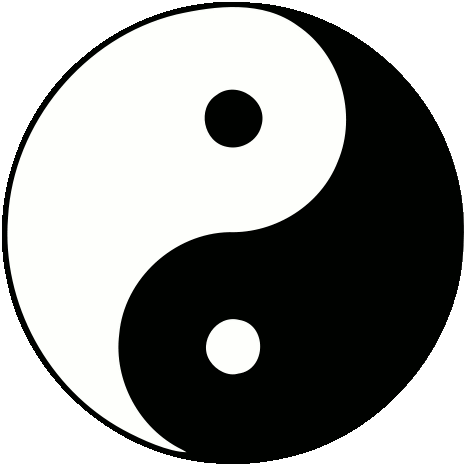
Like the I Ching, Baguazhang emphasizes the interaction of yin and yang.
Hard becomes soft.
Forward becomes backward.
Inside becomes outside.
Attack becomes defense.
The practitioner never remains committed to one quality for too long.
Instead, opposites transform into one another naturally.
This ability to shift between complementary states gives Baguazhang its remarkable adaptability.
Philosophy Through Practice
One of the beautiful aspects of Baguazhang is that students do not need to become scholars of the I Ching before beginning practice.
The body learns first.
Walking the circle teaches balance.
Turning develops adaptability.
Changing palms cultivates flexibility.
Only later do many students recognize that these physical experiences reflect ideas described in the Book of Changes thousands of years ago.
Movement becomes philosophy in action.
Does Every Technique Correspond to a Trigram?
This is a question that often generates discussion among practitioners.
Different Baguazhang lineages have developed different methods of relating techniques to the Eight Trigrams.
Some preserve detailed correspondences.
Others treat the trigrams primarily as guiding principles rather than assigning every movement a specific symbolic meaning.
There is no single universal system shared by every lineage.
What all traditional branches agree upon is that the spirit of the art is one of continual transformation rather than rigid technique.
Learning Cheng Style Baguazhang at Dragon Phoenix
At Dragon Phoenix, students begin by developing posture, stepping, and circle walking before progressing through the 8 Turning Palms, the 8 Mother Palms, the 64 Palms, partner applications, and traditional weapons.
Throughout this progression, students gradually discover that Baguazhang is more than a collection of techniques.
It is a way of understanding movement.
The principles of change described in the I Ching are experienced physically through stepping, turning, adapting, and maintaining balance while constantly moving.
The philosophy supports the training.
The training brings the philosophy to life.
Living the Book of Changes
The I Ching teaches that change is inevitable.
Baguazhang teaches us how to move within that change.
One uses symbols.
The other uses the body.
The Eight Trigrams are not simply names or diagrams.
They remind practitioners that no situation remains fixed.
Every moment contains the possibility of transformation.
This is why Baguazhang has fascinated martial artists for generations.
It is not simply an art of striking or throwing.
It is an art of adaptation.
An art of movement.
An art of change.
And in that respect, it remains one of the clearest living expressions of the philosophy found within the Book of Changes.