
Tai Chi's Relationship with the I Ching
Tai Chi is often associated with the ancient Chinese classic known as the I Ching, or Yijing (易經), commonly translated as the Book of Changes. Students quickly encounter familiar ideas such as yin and yang, change, balance, and harmony, all of which appear in both the I Ching and Tai Chi.
This naturally raises an interesting question:
Did Tai Chi come from the I Ching?
The answer is both yes and no.
The I Ching did not teach Tai Chi forms, martial techniques, or training methods. It is not a martial arts manual. Instead, it provided a philosophical framework that helped shape the way generations of Chinese thinkers understood change, balance, and the natural world. These same ideas became deeply woven into the practice of Tai Chi.
At Dragon Phoenix, we teach Tai Chi as a traditional martial art while also helping students appreciate the philosophy that has influenced its development for centuries.
What Is the I Ching?
The I Ching, or Book of Changes, is one of the oldest surviving Chinese classics, with origins stretching back more than 3,000 years.
Originally used as a system of divination, it gradually became one of the foundational texts of Chinese philosophy. Scholars, military strategists, physicians, artists, and martial artists have all studied its ideas.
Rather than describing a fixed world, the I Ching teaches that everything is constantly changing.
Day becomes night.
Winter becomes spring.
Strength becomes softness.
Expansion becomes contraction.
The central lesson is that change is not the exception.
It is the natural condition of life.
The Meaning of "Tai Chi"
The very name Taijiquan (太極拳) reflects ideas found within classical Chinese philosophy.
Tai Ji (太極) is often translated as "Supreme Ultimate" or "Great Ultimate."
In traditional thought, Taiji represents the state from which yin and yang emerge. As these complementary forces interact, they give rise to the countless changes that shape the natural world.
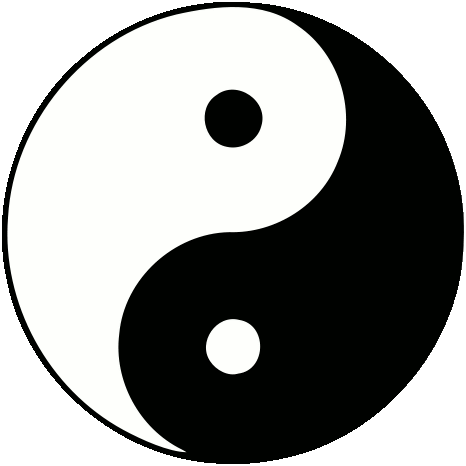
The famous Taijitu, commonly known as the yin-yang symbol, illustrates this relationship. It reminds us that opposites are not enemies. Each contains the seed of the other, and each transforms into the other over time.
Tai Chi seeks to embody these ideas through movement.
Yin and Yang in Practice
The relationship between Tai Chi and the I Ching becomes most obvious through the principle of yin and yang.
Every Tai Chi movement contains complementary qualities.
One leg bears weight while the other becomes light.
One hand advances while the other withdraws.
The body stores energy before releasing it.
Softness becomes firmness.
Movement returns to stillness.
These are not separate actions.
They depend upon one another.
Just as the I Ching teaches that yin and yang continually transform, Tai Chi teaches practitioners to move smoothly between these complementary states without becoming rigid or disconnected.
Change Is the Heart of Tai Chi
If there is one idea that connects Tai Chi and the I Ching more than any other, it is change.
Nothing in Tai Chi remains static.
Weight shifts continuously.
The waist turns.
The arms spiral.
Breathing changes naturally.
Attention moves from one point to another.
Even standing meditation is not truly still. The body is constantly making subtle adjustments to maintain balance.
This reflects one of the central lessons of the I Ching:
Success comes not from resisting change, but from understanding and adapting to it.
Balance Is Dynamic
People often think of balance as standing perfectly still.
The I Ching suggests something different.
Balance is a dynamic process.
It is the continual adjustment between complementary forces.
Tai Chi develops this understanding physically.
Students are always shifting weight.
Adjusting posture.
Maintaining alignment.
Responding to movement.
Rather than trying to freeze the body into one position, practitioners learn to remain balanced while constantly changing.
This lesson extends far beyond martial arts.
The Martial Connection
Tai Chi is a martial art, and the influence of the I Ching can also be seen in its martial strategy.
Instead of opposing force directly, practitioners learn to adapt.
If an opponent pushes, you do not necessarily push back.
You may yield.
Redirect.
Neutralize.
Or change angle.
The appropriate response depends upon the situation.
This flexibility reflects the broader philosophy of the I Ching, which encourages responding according to changing circumstances rather than relying on fixed solutions.
Chen Style and Yang Style
Whether practicing Chen Style or Yang Style, students encounter the same philosophical foundation.
Chen Style expresses these ideas through:
silk-reeling energy
changes in rhythm
spiraling movement
fajin (explosive issuing power)
Yang Style emphasizes:
continuous flow
even tempo
relaxed movement
refined transitions
Although their outward appearance differs, both styles teach students to embody balance, adaptability, and continuous transformation.
The philosophy remains the same.
The I Ching Is Not Required Reading
Some students worry that they must study the I Ching before learning Tai Chi.
Fortunately, that is not the case.
Tai Chi can be practiced and enjoyed without any background in Chinese philosophy.
Many students spend years developing the physical art before becoming interested in its cultural and philosophical roots.
Others enjoy exploring both together.
Understanding the I Ching can deepen one's appreciation of Tai Chi, but the principles are experienced through movement long before they are understood intellectually.
Learning Through the Body
One of the unique qualities of Tai Chi is that it teaches philosophy through physical experience.
Instead of simply reading about balance, students learn balance by standing on one leg.
Instead of discussing change, they experience it through continuous movement.
Instead of debating yin and yang, they feel the relationship between fullness and emptiness, softness and firmness, expansion and contraction.
The body becomes a teacher.
Over time, ideas that once seemed abstract begin to feel natural.
Tai Chi at Dragon Phoenix
At Dragon Phoenix, students study traditional Chen Style and Yang Style Tai Chi through progressive training that emphasizes posture, body mechanics, martial applications, and internal principles.
While philosophical ideas such as yin and yang provide valuable context, the primary focus remains on developing skill through consistent practice.
Students discover that the principles described in the I Ching are not merely ideas to be discussed.
They are qualities that emerge naturally through correct movement and patient training.
A Living Expression of Change
The I Ching teaches that change is the fundamental nature of the universe.
Tai Chi teaches us to move gracefully within that change.
One does so through words.
The other through movement.
Together they remind us that strength and softness are partners, not opposites.
That balance is something we continually create rather than something we permanently achieve.
And that the greatest lessons are often learned not by resisting change, but by learning how to move with it.
For generations, these shared ideas have helped shape Tai Chi into far more than a series of movements.
They have made it a lifelong practice of balance, awareness, and continual transformation.