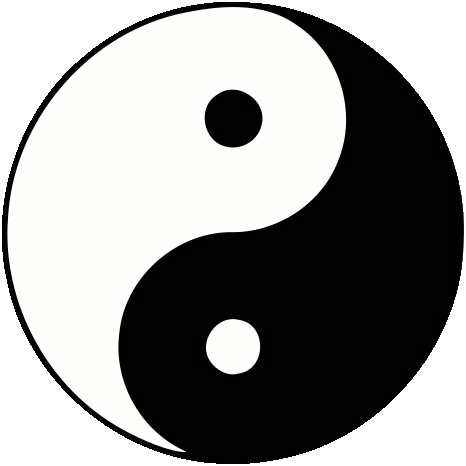

How Tai Chi and Xingyiquan Complement Each Other
To many people, Tai Chi and Xingyiquan seem like opposites.
Tai Chi is widely recognized for its slow, flowing movements and relaxed pace. Xingyiquan is known for its direct, explosive techniques and decisive forward pressure. One appears soft. The other appears forceful.
Yet beneath the surface, these two traditional internal martial arts share many of the same principles.
At Dragon Phoenix, we teach both Chen Style Tai Chi and Xingyiquan because each art develops qualities that naturally strengthen the other. Rather than competing, they offer different perspectives on the same internal principles. Students who practice both often find that progress in one art deepens their understanding of the other.
A Shared Internal Foundation
Although their movements are different, Tai Chi and Xingyiquan are both traditional Chinese internal martial arts.
Both emphasize:
whole-body movement
structural alignment
relaxation without collapse
power generated from the legs and waist
coordinated breathing
focused intention
efficient body mechanics
Neither art depends on muscular strength alone.
Instead, both teach practitioners to move as a single connected body, allowing force to travel from the ground, through the legs and waist, and into the hands.
The methods are different.
The principles are remarkably similar.
Chen Tai Chi and Xingyiquan Share Fajin
One of the strongest connections between Xingyiquan and Chen Style Tai Chi is fajin (發勁)—the ability to issue power explosively through the entire body.
Many people are familiar only with the slow practice of Tai Chi and assume the art never moves quickly.
That is true of some training methods, but not of traditional Chen Style.
Chen Tai Chi includes moments of explosive issuing power within its forms. Slow, controlled movements suddenly transform into fast, powerful expressions before returning to relaxed motion. These changes teach students how to remain relaxed until the exact moment power is needed.
Xingyiquan also emphasizes fajin, but it expresses it differently.
Rather than alternating between slow and fast movement, Xingyi often trains explosive power from the beginning. Its direct stepping, clear intention, and whole-body coordination allow power to be delivered efficiently and decisively.
Practicing both arts helps students understand that fajin is not simply about speed or strength.
It is about releasing power through a connected body at precisely the right moment.
Tai Chi Teaches Relaxation
One of Tai Chi's greatest gifts is teaching relaxation.
This does not mean becoming limp or passive.
Instead, students learn to release unnecessary tension while maintaining structure and connection.
This relaxed quality allows movement to become smoother, breathing to become more natural, and power to travel through the body without interruption.
For Xingyiquan practitioners, this lesson is invaluable.
Without relaxation, direct power easily becomes stiff power.
Tai Chi teaches students that softness and strength are not opposites.
In fact, true power depends upon relaxation.
Xingyiquan Teaches Commitment
If Tai Chi teaches relaxation, Xingyiquan teaches commitment.
Once the practitioner decides to move, the entire body commits together.
There is no hesitation.
No wasted motion.
Every movement has clear intention.
This quality helps Tai Chi practitioners tremendously.
Many beginners perform Tai Chi beautifully but hesitate when expressing martial intention.
Xingyiquan encourages confidence.
It teaches students to move decisively while maintaining the relaxed body mechanics they developed through Tai Chi.
Different Expressions of the Same Power
One interesting lesson from studying both arts is realizing that they generate power in remarkably similar ways.
Both begin with the feet.
Both rely on the legs.
Both direct movement through the waist.
Both require whole-body connection.
The difference lies primarily in expression.
Tai Chi often conceals power within flowing movement.
Xingyiquan expresses power directly and immediately.
One teaches subtlety.
The other teaches clarity.
Together they reveal a deeper understanding of internal power.
Root and Drive
Tai Chi excels at developing root.
Students learn to settle their weight, maintain balance, and remain stable under pressure.
This rootedness becomes an excellent foundation for Xingyiquan.
When a Xingyi practitioner has a strong root, forward power becomes much more effective because it is supported by the entire body rather than isolated muscular effort.
Conversely, Xingyi teaches Tai Chi practitioners how to carry that root forward without losing structure.
The result is movement that is both grounded and purposeful.
Listening and Intention
Tai Chi is famous for developing sensitivity through practices such as push hands.
Students learn to feel subtle changes in pressure, timing, and balance.
This ability to listen improves every aspect of martial training.
Xingyiquan contributes a different quality.
It develops intention.
Rather than waiting too long or second-guessing, students learn to recognize an opportunity and commit fully.
Together these arts create a balanced martial mindset.
Tai Chi teaches you to perceive.
Xingyi teaches you to act.
Health Benefits
Both Tai Chi and Xingyiquan contribute to long-term health.
Regular practice develops:
balance
coordination
posture
leg strength
mobility
concentration
body awareness
Tai Chi is especially well known for promoting relaxation and mindful movement.
Xingyiquan adds dynamic whole-body coordination and powerful structural development.
Practicing both creates a balanced training experience that challenges the body in different ways while preserving the internal principles shared by both systems.
Why Dragon Phoenix Teaches Both
At Dragon Phoenix, Chen Style Tai Chi and Xingyiquan are not viewed as separate or competing arts.
Each strengthens the other.
Tai Chi teaches students how to relax, root, listen, and move with continuity.
Xingyiquan teaches students how to express intention, issue power, and move with decisive commitment.
Both preserve the traditional practice of fajin.
Both develop whole-body connection.
Both help students understand that internal martial arts are not defined by slow or fast movement, but by how the body generates and expresses power.
Many students begin with one art and later explore the other.
Rather than starting over, they discover familiar principles expressed through a different language of movement.
Two Arts, One Understanding
Tai Chi and Xingyiquan may appear very different on the outside, but together they reveal the richness of the internal martial arts.
Tai Chi teaches patience.
Xingyiquan teaches decisiveness.
Tai Chi teaches relaxation.
Xingyiquan teaches commitment.
Tai Chi teaches how to receive.
Xingyiquan teaches how to enter.
Both teach whole-body power.
Both cultivate fajin.
Both remind us that true martial skill comes not from muscular effort, but from a body that is connected, balanced, and guided by clear intention.
At Dragon Phoenix, this is why we teach both arts.
Not because one completes the other.
But because each shines a light on principles that help students understand the other more deeply.
Together they offer a richer, more complete path through the traditional internal martial arts.