
How Does Tai Chi Relate to Traditional Chinese Medicine?
Tai Chi is often recommended alongside acupuncture, herbal medicine, and qigong as part of a healthy lifestyle. Because of this, many people assume Tai Chi is a branch of Traditional Chinese Medicine (TCM).
It isn't.
Tai Chi is a martial art, not a medical treatment. It was developed as a complete fighting system that also cultivates health, balance, and longevity. However, Tai Chi and Traditional Chinese Medicine share many of the same ideas about how the body functions, which is why they complement one another so naturally.
At Dragon Phoenix, we teach traditional Tai Chi as a martial art with profound health benefits. Understanding its relationship to Chinese medicine helps students appreciate why generations of practitioners have viewed movement, health, and martial skill as deeply connected.
Shared Roots in Traditional Chinese Culture
Tai Chi and Traditional Chinese Medicine developed within the same cultural and philosophical traditions.
Both were influenced by classical Chinese ideas about:
balance
harmony
yin and yang
the Five Elements
the relationship between mind and body
living in accordance with nature
These ideas were not unique to medicine or martial arts.
They shaped Chinese philosophy, art, agriculture, military strategy, and daily life for centuries.
Because Tai Chi and Traditional Chinese Medicine emerged from this shared worldview, they naturally use much of the same language.
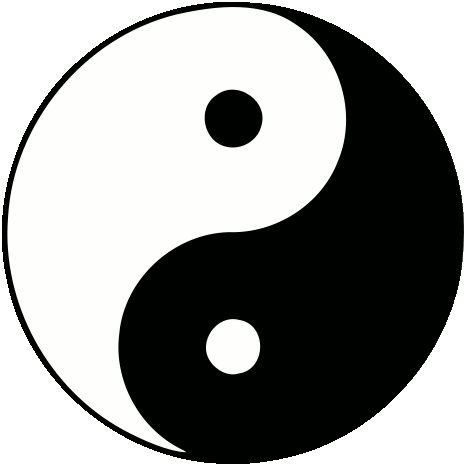
Yin and Yang
Perhaps the best-known concept shared by Tai Chi and Chinese medicine is yin and yang.
Rather than viewing opposites as enemies, yin and yang describe complementary qualities that constantly transform into one another.
Examples include:
soft and hard
movement and stillness
full and empty
expansion and contraction
activity and rest
In Tai Chi, these principles appear in every movement.
Weight shifts from one leg to the other.
One arm extends while the other withdraws.
The body alternates between storing and releasing energy.
In Traditional Chinese Medicine, yin and yang describe healthy balance within the body's systems.
Although the applications differ, the underlying principle is the same:
Health and skill both arise from balance rather than excess.
Qi: A Shared Concept
Another important connection is the idea of qi (氣).
Qi is often translated as "energy," but this translation can be misleading because the Chinese concept is much broader.
Traditional Chinese medicine describes qi as the functional activity that supports life. It is discussed in relation to breathing, circulation, digestion, movement, warmth, and many other physiological processes. Different kinds of qi are described for different functions within the body.
In Tai Chi, practitioners use the term qi to describe developing coordinated, efficient movement rather than relying on isolated muscular effort.
While qi is an important concept within both traditions, it should not be understood as a mystical force.
Instead, it represents the body's ability to function as an integrated whole.
Movement as Part of Health
One of the most obvious relationships between Tai Chi and Chinese medicine is the importance of movement.
Traditional Chinese medicine has long recognized that regular, appropriate movement contributes to overall well-being.
Tai Chi provides exactly that.
Its slow, mindful movements encourage:
balance
coordination
posture
mobility
controlled breathing
body awareness
Unlike high-impact exercise, Tai Chi emphasizes relaxed, continuous movement that many people can practice throughout their lives.
This makes it an excellent complement to other healthy habits.
Breathing and Relaxation
Both Tai Chi and Traditional Chinese Medicine recognize the importance of calm, natural breathing.
During Tai Chi practice, breathing is not forced.
Instead, students gradually learn to allow the breath to coordinate naturally with movement.
Relaxation also plays an important role.
This does not mean becoming limp.
It means releasing unnecessary muscular tension while maintaining good posture and structure.
Many students find that this relaxed state carries over into daily life, improving both physical comfort and mental focus.
Body Awareness
Traditional Chinese medicine encourages paying attention to the body's condition rather than ignoring it.
Tai Chi develops this awareness through movement.
Students become more sensitive to:
posture
balance
tension
coordination
weight distribution
breathing
This increased body awareness often helps practitioners move more efficiently during everyday activities.
Many people notice improvements not only during practice, but also while walking, lifting, sitting, or climbing stairs.
Modern Scientific Research
Although Tai Chi developed long before modern medicine, researchers have increasingly studied its effects over the past several decades.
Numerous studies have associated regular Tai Chi practice with improvements in:
balance
mobility
lower-body strength
coordination
fall prevention in older adults
quality of life
stress management
These findings help explain why Tai Chi is frequently recommended as a gentle form of physical activity for many populations.
It is important to recognize, however, that scientific research evaluates Tai Chi using modern medical methods rather than traditional theories such as qi or meridians.
Both perspectives offer valuable ways of understanding the practice.
Tai Chi Is Not Medical Treatment
Because Tai Chi is associated with health, some people assume it can replace medical care.
This is not the traditional view.
Tai Chi should not be considered a substitute for appropriate medical diagnosis or treatment.
Instead, it can be viewed as one part of a healthy lifestyle that may complement conventional healthcare and, for those who choose it, Traditional Chinese Medicine.
Many practitioners work with their healthcare providers while also practicing Tai Chi to support overall wellness.
Tai Chi as a Lifelong Practice
One reason Tai Chi has remained closely associated with health is that it can be practiced throughout nearly every stage of life.
Beginners can learn at a comfortable pace.
Older adults can continue refining familiar movements for decades.
Experienced practitioners continue discovering new layers of understanding long after they have memorized the forms.
The practice evolves as the practitioner evolves.
This emphasis on lifelong development reflects the broader Chinese understanding that health is not something achieved once and forgotten.
It is something cultivated over time.
Learning Tai Chi at Dragon Phoenix
At Dragon Phoenix, students study traditional Tai Chi as a complete martial art while also experiencing the many health benefits that arise from correct practice.
Whether learning Chen Style or Yang Style Tai Chi, students develop posture, balance, body awareness, coordinated breathing, and efficient movement through a structured progression that respects the traditional roots of the art.
The goal is not simply to perform beautiful movements.
It is to develop a healthier, more connected body while preserving the martial principles that have defined Tai Chi for centuries.
A Shared Philosophy of Balance
Tai Chi and Traditional Chinese Medicine grew from the same cultural roots, but they serve different purposes.
Chinese medicine seeks to understand and support health through diagnosis and treatment.
Tai Chi develops health through mindful movement, body mechanics, and lifelong practice.
They meet in their shared appreciation of balance, relaxation, and the remarkable ability of the human body to adapt and improve.
For generations, practitioners have recognized that movement can be a powerful part of healthy living.
Tai Chi reminds us that caring for the body does not always require doing more.
Sometimes it begins by moving with greater awareness, greater balance, and greater intention.
References
Kaptchuk, Ted J. The Web That Has No Weaver: Understanding Chinese Medicine. McGraw-Hill.
Jahnke, R., Larkey, L., Rogers, C., Etnier, J., & Lin, F. "A Comprehensive Review of Health Benefits of Qigong and Tai Chi." American Journal of Health Promotion, 2010.
Wayne, Peter M., & Fuerst, Mark L. The Harvard Medical School Guide to Tai Chi. Shambhala Publications.
National Center for Complementary and Integrative Health. "Tai Chi: What You Need To Know."
World Health Organization. WHO International Standard Terminologies on Traditional Medicine in the Western Pacific Region.