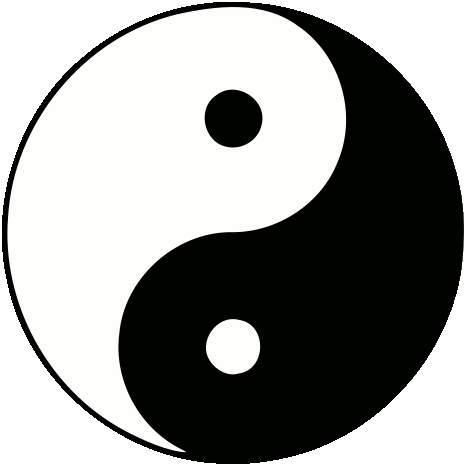

How Baguazhang and Xingyiquan Complement Each Other
At first glance, Baguazhang and Xingyiquan seem like complete opposites.
Baguazhang is constantly moving. Practitioners walk circles, change directions, and approach from unexpected angles. Xingyiquan appears much more direct. Its movements are efficient, straightforward, and decisive, driving through the center with focused intention.
Because they look so different, some people assume they have little in common.
In reality, they share the same foundation and complement one another remarkably well.
At Dragon Phoenix, we teach both Cheng Style Baguazhang and Xingyiquan because each art develops qualities that strengthen the other. Rather than competing, they work together to create a more complete understanding of internal martial arts. Many practitioners discover that skills developed in one art naturally improve their ability in the other.
A Shared Internal Foundation
Although Baguazhang and Xingyiquan express themselves differently, they are both traditional Chinese internal martial arts.
Both emphasize:
whole-body movement
relaxed but connected structure
power generated from the legs and waist
coordinated breathing
mental focus
efficient body mechanics
developing skill through consistent practice
Neither art depends on muscular strength alone.
Instead, both teach practitioners to move as one connected body, allowing power to travel from the ground through the waist and into the hands.
The methods differ.
The principles are remarkably similar.
Xingyiquan Teaches Directness
One of Xingyiquan's greatest strengths is its simplicity.
That does not mean it is easy.
In fact, Xingyi is often described as one of the most difficult arts to perform correctly because its movements are so direct that mistakes become immediately obvious.
Xingyiquan teaches students to:
move forward with commitment
generate whole-body power
maintain strong structure
issue force efficiently
keep intention clear
eliminate unnecessary movement
The Five Element Fists are simple in appearance, yet they contain lessons that practitioners continue refining for decades.
Xingyi develops confidence.
Once a decision is made, the body commits completely.
Baguazhang Teaches Adaptability
If Xingyi teaches commitment, Baguazhang teaches flexibility.
The central idea of Baguazhang is change.
Rather than remaining directly in front of an opponent, practitioners learn to:
change angles
circle around force
reposition continuously
remain mobile
adapt to changing situations
stay balanced while moving
Circle walking develops far more than footwork.
It teaches the body to remain relaxed while constantly changing direction.
Students become comfortable moving where others become trapped.
This ability to adapt complements Xingyi beautifully.
Directness and Change
Imagine facing an opponent.
Xingyi asks:
"What is the most direct path?"
Baguazhang asks:
"What is the best angle?"
Both questions are valuable.
Sometimes the shortest path is the correct one.
Sometimes changing position creates a much greater advantage.
A practitioner who understands both arts gains more options.
Instead of relying on a single strategy, they learn to respond according to the situation.
Structure and Mobility
Xingyiquan develops exceptionally strong body structure.
Students spend significant time refining standing practice, body alignment, and the relationship between intention and movement.
This structural integrity becomes a tremendous benefit when studying Baguazhang.
A well-developed Xingyi practitioner often discovers that stronger alignment improves circle walking, turning, and balance.
Likewise, Baguazhang's mobility helps Xingyi practitioners avoid becoming too fixed.
Continuous stepping teaches them to maintain structure while remaining adaptable.
The result is movement that is both stable and alive.
Different Footwork, Shared Principles
The footwork of the two arts appears very different.
Xingyi generally emphasizes direct advancing steps that support forward pressure.
Baguazhang develops:
Mud-Wading Step
Hook Step
Swing Step
circle walking
continuous changes of direction
Despite these differences, both systems seek efficient movement.
Neither encourages wasted motion.
Neither relies on speed alone.
Both teach the practitioner to arrive in the right place at the right time while remaining connected to the ground.
Different Expressions of Power
Power also appears different.
Xingyi often expresses force explosively through direct forward intention.
Baguazhang expresses power through turning, spiraling, and changing direction.
Yet both methods begin the same way.
The feet connect to the ground.
The legs generate force.
The waist directs the movement.
The upper body remains connected.
The hands simply express what the body has already created.
Studying both arts helps practitioners understand that internal power is not tied to one particular technique.
It is a quality that can appear in many different forms.
Martial Applications
Both arts are complete fighting systems.
Xingyi often seeks to overwhelm the opponent with decisive forward pressure and efficient technique.
Baguazhang often seeks to outmaneuver the opponent through movement and changing angles.
Together they provide complementary tactical options.
Sometimes direct entry is appropriate.
Sometimes circling creates a better opportunity.
Rather than forcing one strategy onto every situation, practitioners learn to recognize which approach best fits the moment.
Mental Development
The two arts also cultivate different mental qualities.
Xingyi develops determination.
Students learn to commit without hesitation.
The mind becomes focused and decisive.
Baguazhang develops adaptability.
Students become comfortable with uncertainty and continuous change.
The mind learns to remain flexible without losing direction.
Together they create balance.
Confidence without rigidity.
Flexibility without indecision.
Health Benefits
Both arts offer lifelong physical and mental benefits.
Training develops:
stronger legs
better posture
improved balance
greater coordination
body awareness
concentration
efficient movement
Because the training methods differ, practicing both exposes the body to a broader range of movement patterns.
Many practitioners find that the stability developed through Xingyi supports their Baguazhang, while the mobility developed through Baguazhang keeps their Xingyi relaxed and fluid.
Why Dragon Phoenix Teaches Both
At Dragon Phoenix, Cheng Style Baguazhang and Xingyiquan are not viewed as competing systems.
They are complementary paths.
Xingyi teaches students how to move with clarity and commitment.
Baguazhang teaches students how to adapt and change without losing their center.
Each answers questions the other naturally raises.
Many students begin with one art and later explore the other.
Rather than starting over, they often discover that the principles they have already learned transfer naturally between the two systems.
The body begins recognizing familiar ideas expressed through different movement.
Two Expressions of Internal Martial Arts
Some people compare Baguazhang and Xingyiquan by asking which one is better.
History suggests a different question.
How can they make each other stronger?
Xingyi teaches you how to move directly.
Baguazhang teaches you how to move freely.
Xingyi develops decisive intention.
Baguazhang develops adaptable strategy.
Xingyi builds structure.
Baguazhang develops mobility.
Together they create a martial artist who is both stable and flexible, powerful and adaptable, decisive and creative.
At Dragon Phoenix, this is why we teach both arts.
Not because one is missing something the other possesses.
But because each reveals another perspective on the same internal principles.
When practiced together, Baguazhang and Xingyiquan become more than two separate martial arts.
They become two ways of understanding movement, balance, and change—and together they help students develop a richer, deeper appreciation of the internal martial arts as a whole.