
Does Tai Chi Conflict with Religion?
One of the most common questions people ask before starting Tai Chi is:
"Will practicing Tai Chi conflict with my religious beliefs?"
For many people, this is an important concern.
The good news is that traditional Tai Chi is not a religion. It does not ask students to worship anyone, adopt a new belief system, or abandon their existing faith. At its heart, Tai Chi is a traditional Chinese martial art that also promotes health, balance, coordination, and self-improvement.
At Dragon Phoenix, students come from a wide variety of religious backgrounds, as well as those who do not identify with any religion at all. Our focus is on teaching authentic Chen Style and Yang Style Tai Chi in a welcoming and respectful environment.
Tai Chi Is a Martial Art
Tai Chi, or Taijiquan (太極拳), literally means "Supreme Ultimate Fist."
The word Quan (拳) means fist or boxing, identifying Tai Chi as a martial art.
Over the centuries, Tai Chi also became valued for its health benefits, meditation in motion, and methods of personal cultivation.
While these aspects can feel deeply meaningful, they do not make Tai Chi a religion.
Practicing Tai Chi is much like practicing yoga as exercise, fencing, archery, or another traditional discipline. It is a system of movement and training rather than a system of worship.
Chinese Philosophy Is Not the Same as Religion
Traditional Tai Chi developed within Chinese culture.
As a result, many of its ideas were influenced by classical Chinese philosophy, including concepts found in:
Daoism
Confucianism
traditional Chinese medicine
the I Ching (Book of Changes)
These influences helped shape the language and way of thinking surrounding Tai Chi.
However, studying ideas from another culture does not require adopting that culture's religious beliefs.
For example, learning about the concepts of yin and yang is no more an act of religious worship than studying Greek philosophy requires believing in Zeus.
Understanding cultural ideas helps students better appreciate the history of the art.
It does not require changing their own faith.
What About Yin and Yang?
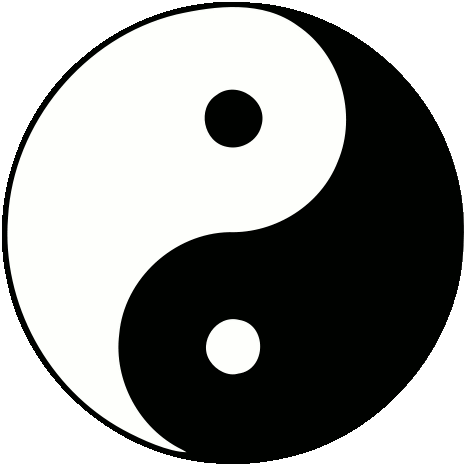
The symbol of yin and yang is probably the most recognizable image associated with Tai Chi.
Some people mistakenly assume it represents a religious symbol.
In reality, yin and yang describe the observation that many qualities in nature exist as complementary pairs.
Examples include:
day and night
activity and rest
expansion and contraction
firmness and softness
In Tai Chi, these ideas help explain movement, balance, and body mechanics.
They are descriptive principles, not objects of worship.
Whether a student accepts them as philosophical ideas, practical observations, or simply useful teaching tools is a personal choice.
Meditation Does Not Mean Worship
Tai Chi is sometimes described as moving meditation.
This phrase can also create confusion.
In Tai Chi, meditation simply means developing mindful awareness.
Students learn to pay attention to:
posture
breathing
relaxation
balance
movement
concentration
Mindfulness during movement is not the same as participating in a religious ceremony.
Many people find that practicing Tai Chi actually helps them become calmer, more focused, and better able to engage with their own faith and daily life.
People of Many Faiths Practice Tai Chi
Around the world, Tai Chi is practiced by people from many different religious traditions, including Christians, Jews, Muslims, Buddhists, Hindus, and people with no religious affiliation.
Many appreciate Tai Chi simply as:
a martial art
a form of exercise
a method of improving balance
a way to reduce stress
a lifelong practice of personal development
People often interpret the philosophical aspects of Tai Chi through the lens of their own beliefs.
There is no requirement to adopt any particular worldview in order to benefit from training.
Respect for Individual Beliefs
Traditional martial arts have long emphasized respect.
That respect extends to the beliefs of every student.
At Dragon Phoenix, we encourage students to ask questions about the history and philosophy of Tai Chi while recognizing that each person brings their own experiences and convictions to training.
No one is expected to compromise their religious beliefs in order to participate.
Our goal is to teach authentic martial arts in an environment that welcomes everyone.
What Tai Chi Actually Teaches
Rather than promoting a religion, Tai Chi develops practical skills such as:
balance
coordination
posture
relaxation
body awareness
discipline
patience
perseverance
As students progress, they also learn traditional martial principles such as rooting, whole-body connection, Push Hands, and martial applications.
These are skills developed through practice.
They are not matters of religious belief.
Appreciating History Without Adopting Beliefs
Learning the history of Tai Chi naturally includes discussing Chinese culture and philosophy.
Understanding these influences helps explain why the art developed as it did.
Appreciating history, however, is not the same as practicing a religion.
Just as someone can study medieval European history without adopting medieval Christianity, or study Japanese martial arts without adopting Shinto beliefs, students can learn about Tai Chi's cultural background while remaining fully committed to their own faith.
Knowledge and respect do not require religious agreement.
Tai Chi at Dragon Phoenix
At Dragon Phoenix, we teach traditional Chen Style and Yang Style Tai Chi as authentic martial arts with deep historical roots.
We believe understanding the cultural background of Tai Chi enriches the learning experience, but we also recognize that every student's spiritual journey is personal.
Our classes focus on developing sound body mechanics, martial skill, health, and personal growth in an atmosphere of mutual respect.
Students are free to embrace the aspects of Tai Chi that support their goals while remaining true to their own beliefs and values.
A Practice That Welcomes Everyone
For centuries, Tai Chi has helped people improve their balance, health, confidence, and understanding of movement.
Its principles are rooted in observation, discipline, and continuous improvement—not in religious conversion.
Whether you are deeply religious, spiritually curious, or not religious at all, Tai Chi can be practiced as a traditional martial art that complements, rather than replaces, your personal beliefs.
The goal of Tai Chi is not to tell you what to believe.
Its purpose is to help you move with greater balance, awareness, and skill—qualities that people from every background can appreciate.