
What Is Daoism? A Beginner’s Introduction
Daoism can be difficult to explain in a single sentence, partly because Daoism itself tends to be suspicious of putting something as large as life into a neat little box.
At Dragon Phoenix, we study Dao philosophy through texts such as the Dao De Ching, Lieh Tzu, I-Ching, and writings connected with Internal Alchemy. We explore these teachings through stories, explanations, questions, and discussion. The goal is not to tell you what you are supposed to believe. It is to give you something worth thinking about, then let you consider how it relates to your own experience.
That approach is important because Daoism is not simply a collection of rules. Again and again, Daoist writings ask us to look at how we are living, what assumptions we have made, and whether our efforts are actually bringing us closer to the life we are trying to create.
So, what is Daoism?
What Does “Dao” Mean?
The Chinese word Dao (道) is usually translated as “Way” or “Path.”
That translation is helpful, but it does not capture everything the word can mean.
In early Chinese thought, dao could refer to a road, a course of action, a way of doing something, or a way of living. Within texts such as the Dao De Ching, the idea becomes much larger. Dao can refer to the underlying way in which the world unfolds—the patterns and processes through which things arise, change, relate to one another, and eventually pass away. Scholar Livia Kohn describes Dao as fundamental to the way the world functions, while also emphasizing the importance of naturalness, change, and the unfolding of life.
This is one reason definitions become difficult.
The Dao is not simply a set of commandments telling us what to do. It is something we learn to observe.
Think about water.
Water can be soft, but given enough time it can reshape stone. It does not normally fight its way downhill. It responds to the landscape in front of it. Put it into a cup and it takes the shape of the cup. Give it another opening and it moves somewhere else.
The Dao De Ching repeatedly uses images like water to encourage us to reconsider our usual assumptions about strength, weakness, action, control, and success. The point is not that we should literally behave like water in every circumstance. The image gives us another way to think.
Where in your own life are you using more force than the situation requires?
That is a very Daoist kind of question.
Daoism Is More Than One Thing
People sometimes ask whether Daoism is a philosophy or a religion.
The most accurate answer is that Daoism has developed as both, along with traditions of self-cultivation, ritual, meditation, health practices, and other forms of religious and cultural life.
Scholars frequently distinguish between “philosophical Daoism” and “religious Daoism,” but that division can become misleading when it is treated as an absolute boundary. The traditions have influenced one another throughout Chinese history, and modern scholarship generally presents Daoism as much broader and more complicated than two completely separate categories.
The earliest philosophical texts associated with Daoism developed during ancient China's Warring States period, although the category “Daoist” was applied to thinkers such as Laozi and Zhuangzi later. Organized Daoist religious communities emerged centuries afterward, particularly during the second century CE.
At Dragon Phoenix, our Dao Philosophy studies focus on the philosophical side of this enormous tradition. They are not religious instruction, and students do not need to adopt a religious belief or identity to participate. The purpose is to explore the ideas, stories, and questions and see what they may help us understand.
The Dao De Ching
For most beginners, the Dao De Ching—also written Daodejing or, in the older Wade-Giles spelling, Tao Te Ching—is the best-known Daoist text.
“Daoism” and “Taoism” are similarly two English spellings connected with different systems of Romanizing Chinese. Modern scholarship generally uses the Pinyin forms Dao, Daoism, Laozi, and Zhuangzi, while older books often use Tao, Taoism, Lao-tzu, and Chuang-tzu.
The Dao De Ching is traditionally associated with Laozi, although its exact authorship and development are more complicated than the traditional story of one man sitting down and writing the entire book. Ancient manuscript discoveries show that versions of its material circulated and developed over time. The familiar received text contains 81 short chapters and roughly 5,000 Chinese characters.
Those chapters explore subjects including leadership, desire, simplicity, humility, conflict, strength, knowledge, change, and our relationship with the natural world.
Sometimes the writing is very direct.
Sometimes it appears contradictory.
Sometimes you can read three lines and spend the rest of the afternoon wondering what they mean.
That is part of the value of studying it.
Zhuangzi and Learning to Question Our Perspective
Another major text is the Zhuangzi, named for the philosopher Zhuang Zhou.
Where the Dao De Ching often gives us short, poetic statements, the Zhuangzi frequently teaches through strange stories, conversations, humor, exaggeration, and impossible situations. Modern scholarship regards the book as an anthology containing material from multiple hands and periods rather than simply a book written from beginning to end by one author.
The stories often challenge the certainty with which we divide the world into categories.
Useful and useless.
Success and failure.
Beautiful and ugly.
Lucky and unlucky.
Right and wrong.
A Daoist story may begin by making one answer seem obvious and then turn the situation around until you are no longer quite as certain.
This does not necessarily mean that Daoism teaches that nothing matters or that every answer is equally good. It asks us to notice how limited our own perspective can be.
When something happens that you immediately call “bad,” how certain are you that you understand where it will lead?
When someone sees the same event differently, what are they seeing that you are not?
Questions like these appear again and again within Daoist thought.
Wu Wei: Does Daoism Teach Us to “Do Nothing”?
One of the most famous Daoist concepts is wu wei (無為).
It is commonly translated as “non-action,” which can create the impression that Daoism teaches people to sit around and do nothing.
That is usually not a very useful way to understand it.
Wu wei points more toward action that is not unnecessarily forced—responsive action that fits the circumstances rather than struggling against them simply because we have decided everything must happen according to our plan. Scholars discussing classical Daoism describe it in terms of spontaneous or unforced responsiveness rather than simple inactivity.
Imagine a skilled musician.
When someone first learns an instrument, every movement requires attention. Where does this finger go? What note comes next? How hard should I press?
Years later, the musician may play without consciously directing every individual movement.
They are certainly doing something.
But they are no longer forcing every part of the action.
Martial artists experience the same thing. A beginner may try to control every joint and every movement independently. With practice, the body begins to coordinate. Appropriate movement can emerge with less unnecessary tension.
Wu wei invites us to consider where that same principle might appear in life.
Ziran: Naturalness and “Being So of Itself”
Another important idea is ziran (自然).
It is often translated as “naturalness” or “spontaneity.” More literally, it carries the sense of something being “so of itself.”
This does not mean that every impulse you happen to feel is automatically wise. Daoist naturalness is a deeper question about what happens when unnecessary interference, artificial desires, social pressures, and excessive control stop pulling us away from how a situation can naturally develop.
There is an interesting question here.
How much of what we want actually comes from us?
How much comes from what we have been told we should want?
Daoism does not hand us a simple answer. It gives us reasons to examine the question.
Yin and Yang
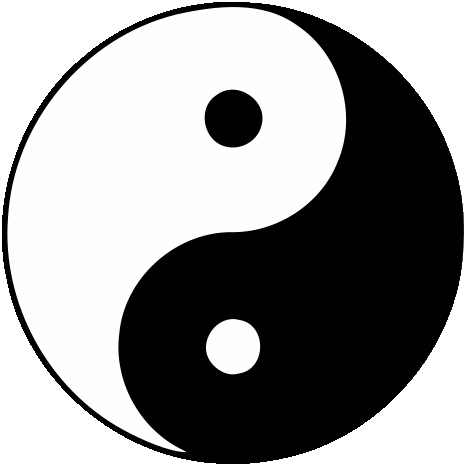
Most people encounter the familiar yin-yang symbol long before they know much about Daoism.
Yin and yang describe complementary tendencies that depend upon and transform into one another: dark and light, receptive and active, inward and outward, rest and movement.
One important clarification is that yin-yang theory was not exclusively Daoist. Ideas of yin and yang belong to a much wider history of Chinese cosmology and thought, although they became deeply connected with Daoist traditions.
The important word is relationship.
Yin and yang are not simply two enemies battling until one destroys the other. Each helps us understand the other.
Without silence, what would sound mean?
Without rest, what would activity mean?
Without yielding, can strength become rigid?
And if you never act decisively, can yielding become weakness?
Daoist thinking often asks us to look beyond one side of an opposition and understand the relationship between the two.
Daoism Is Not About Becoming Passive
This is probably worth saying clearly.
Learning to work with circumstances does not mean allowing circumstances to control you.
Acceptance is not necessarily surrender.
Softness is not necessarily weakness.
Non-action is not necessarily inactivity.
Daoist texts repeatedly play with these apparent contradictions because our first definition of something is not always sufficient.
There are times to move and times to stop.
Times to speak and times to listen.
Times to hold your ground and times to yield.
The difficult part is recognizing which situation you are actually in.
A rulebook cannot make every one of those decisions for us.
Awareness matters.
Do You Have to Believe in Daoism?
No.
At least, belief is not how we approach Dao philosophy at Dragon Phoenix.
You can read a story from the Lieh Tzu, consider the question behind it, disagree with one interpretation, hear someone else's perspective, and leave with something useful to think about.
You do not have to accept everything.
In fact, I would rather you think carefully than simply agree with me.
A philosophical tradition that has been interpreted, debated, commented upon, and reconsidered for more than two thousand years probably should not produce only one possible response.
Read.
Consider.
Question.
Then see whether the idea changes how you understand something in your own life.
How to Begin Studying Daoism
You do not have to understand all of Chinese history before opening the Dao De Ching.
Start with curiosity.
Read a short passage rather than trying to finish the entire book quickly. Notice what catches your attention. Ask what assumption the passage might be challenging. Then return to it later.
Your answer may change.
That is not necessarily a problem.
You changed too.
For readers who would like some guidance, the Dragon Phoenix Dao Philosophy Membership, part of the Dragon Phoenix Online Academy, provides a place to explore these ideas without needing to study martial arts. The library currently contains approximately 100 short video lectures, usually about 4–15 minutes each, exploring the Dao De Ching, Lieh Tzu, I-Ching, Internal Alchemy, and related ideas. New lectures are normally added at a pace of around two each week.
There is no required order, prerequisite knowledge, quiz, assessment, or martial arts training. You can follow whatever subject interests you and return to earlier teachings as your perspective develops. Optional member discussions provide a friendly place to share thoughts and encounter different interpretations; I contribute to those conversations from time to time, but quiet reflection is equally welcome.
The Dao Philosophy Membership is currently $15 per month or $150 per year. Existing Online Academy members whose membership already includes Dao Philosophy do not need a separate subscription.
The purpose is not to give you a collection of answers to memorize.
It is to give you better questions to explore.
And that may be a very good place to begin.
Scholarly Sources and Further Reading
Chan, Alan K. L. “Daoism.” Oxford Bibliographies in Chinese Studies. Oxford University Press, 2013.
Fraser, Chris. Zhuangzi: Ways of Wandering the Way. Oxford University Press, 2024.
Gowans, Christopher W. “Classical Daoism.” In Self-Cultivation Philosophies in Ancient India, Greece, and China. Oxford University Press, 2021.
Kohn, Livia. The Daode Jing: A Guide. Oxford University Press, 2019.
Kohn, Livia. Introducing Daoism. Routledge, 2009.
Liu, Xiaogan. “Daoism: Laozi and Zhuangzi.” In The Oxford Handbook of World Philosophy. Oxford University Press, 2011.
Raz, Gil. “What Is Daoism and Who Is Its Founder?” In Varieties of Religious Invention: Founders and Their Functions in History. Oxford University Press, 2015.